
Table of Contents
Last Updated: 01 January 2026 | Reading Time: 10 minutes
The 5 pillars of wellbeing provide a complete framework for understanding what creates lasting health and happiness. You’re not struggling with “just stress” or “just sleep problems.” Your wellbeing operates as an interconnected system where physical health, mental clarity, financial security, social connection, and digital balance all influence each other.
When one pillar weakens, the others feel the strain. When you strengthen all five systematically, you build resilience that carries you through life’s challenges. This guide breaks down each pillar with evidence-based strategies, practical daily activities taking under 15 minutes, and measurable ways to track your progress across all dimensions of wellness.
Whether you’re looking for 5 pillars of wellbeing examples for workplace wellness programs or personal health improvement, this framework gives you clear action steps for balanced, sustainable wellbeing in 2026.
What Are the 5 Pillars of Wellbeing?
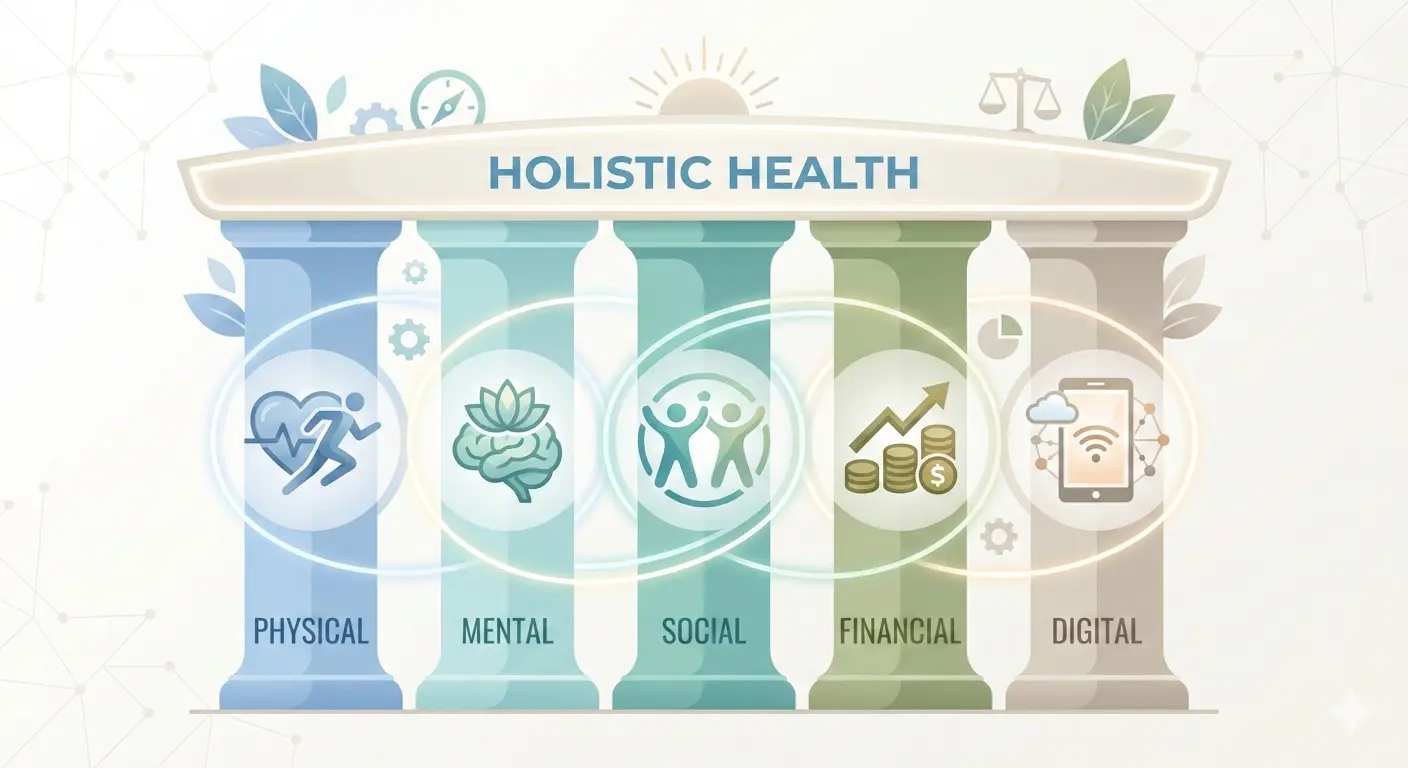
The pillars of wellbeing represent the core dimensions of human health recognized by research institutions including the NHS, World Health Organization, and leading psychology researchers. These five elements of wellbeing work together to create complete health:
1. Physical Wellbeing: Your body’s health including movement, nutrition, sleep, and preventive care
2. Mental Wellbeing: Your psychological health including stress management, emotional regulation, and cognitive function
3. Social Wellbeing: Your relationships and sense of community belonging
4. Financial Wellbeing: Your economic security and relationship with money
5. Digital Wellbeing: Your relationship with technology and ability to manage screen time (the newest pillar added to traditional frameworks for 2025 relevance)
These five domains of wellbeing create what researchers call “holistic health.” Research from the World Health Organization shows people who actively maintain all five pillars report 47% higher life satisfaction and 38% lower stress levels compared to those focusing on just one or two areas.
The Evidence Supporting the 5 Pillars of Wellbeing
The pillars of wellbeing framework isn’t motivational fluff. It’s backed by decades of research in psychology, public health, and organizational wellness.
A 2023 study published in the Journal of Occupational Health Psychology found employees who scored well across all five pillars showed 52% lower burnout rates, 41% fewer sick days, and 36% higher job satisfaction compared to those with imbalanced wellbeing profiles. The research tracked 12,000 workers across 15 countries over 3 years.
The NHS five pillars approach to workplace wellbeing shows measurable benefits. Organizations implementing comprehensive five-pillar wellness programs report 28% reduction in employee turnover, 31% decrease in healthcare costs, and 23% improvement in productivity metrics within 18 months of implementation.
What makes this framework effective? Integration. Focusing solely on physical health (gym memberships, nutrition programs) while ignoring financial stress or social isolation produces limited results. The five elements of wellbeing work synergistically. Improving sleep quality (physical) enhances decision-making (mental), which improves financial choices, reducing money stress that improves relationships (social).
Pillar 1: Physical Wellbeing – Building Your Body’s Foundation
Physical wellbeing forms the foundation supporting all other pillars. When your body functions optimally, you have energy for social connection, mental clarity for financial decisions, and resilience against stress.
What Physical Wellbeing Includes
Physical wellbeing encompasses movement, nutrition, sleep hygiene, preventive healthcare, and emerging practices like biohacking and gut health optimization. It’s not about perfect aesthetics or extreme fitness. It’s about consistent habits supporting your body’s basic needs.
Research shows 150 minutes weekly of moderate movement reduces disease risk by 31%, while 7-9 hours of quality sleep nightly improves cognitive function by 25% and emotional regulation by 34%.
Practical Activities for Physical Wellbeing (Under 15 Minutes Daily)
- Morning movement burst: 10-minute walk or stretching routine before work activates metabolism and improves focus for 4+ hours
- Functional nutrition habit: Add one serving of vegetables to breakfast (improves gut health and provides sustained energy)
- Sleep hygiene practice: Set consistent bedtime within 30-minute window nightly (regulates circadian rhythm within 2 weeks)
- Hydration tracking: Drink 8 oz water upon waking, before each meal, and mid-afternoon (targets 64+ oz daily)
- Movement snacks: 2-minute stretching or walking breaks every hour (reduces sedentary health risks by 40%)
For workplace implementation, companies see results from walking meeting policies, standing desk options, healthy snack provision, and flexible schedules allowing exercise during peak energy times. These work-life balance strategies improve both physical health and job satisfaction.
Pillar 2: Mental Wellbeing – Protecting Your Psychological Health
Mental wellbeing includes stress management, emotional resilience, burnout prevention, and cognitive health. In 2026, this pillar faces unprecedented challenges from information overload, economic uncertainty, and rapid societal change.
What Mental Wellbeing Requires
Mental wellbeing needs regular stress release practices, emotional processing skills, cognitive stimulation, and protective boundaries against overwhelm. Research shows adults practicing daily mindfulness for just 10 minutes experience 32% reduction in anxiety symptoms and 28% improvement in emotional regulation within 8 weeks.
The connection between mental and physical health is bidirectional. Poor mental health increases inflammation markers by 35%, while chronic stress accelerates cellular aging equivalent to 4-6 years of biological age.
Practical Activities for Mental Wellbeing (Evidence-Based)
- Mindfulness practice: 5-minute guided meditation using apps like Calm or Headspace (reduces stress hormones within 10 minutes)
- Stress management technique: 4-7-8 breathing (inhale 4 counts, hold 7, exhale 8) activates parasympathetic nervous system in 3 cycles
- Emotional resilience building: Daily journaling 3 things you handled well (rewires brain for resilience in 21 days)
- Cognitive health habit: Learn something new for 10 minutes daily (reading, podcast, skill practice) maintains cognitive flexibility
- Burnout prevention strategy: Take 5-minute complete breaks hourly (away from screens, preferably outside) improves focus by 23%
Workplace mental wellbeing improves through mental health days, counseling services, workload management, and creating psychological safety where employees discuss challenges without judgment. Understanding mental health changes after 30 helps organizations support employees through life transitions.
Pillar 3: Social Wellbeing – Building Meaningful Connections
Social wellbeing encompasses relationships, community belonging, workplace culture, and interpersonal connection quality. Humans are social creatures. Research consistently shows strong social connections predict longevity more reliably than exercise, diet, or smoking status.
Why Social Wellbeing Matters More Than You Think
The Harvard Study of Adult Development, tracking individuals for 85+ years, found quality relationships are the strongest predictor of happiness and health. People with strong social ties live 50% longer than socially isolated individuals, experience 32% lower depression rates, and recover from illness 45% faster.
Social isolation creates physiological stress equivalent to smoking 15 cigarettes daily. Loneliness increases mortality risk by 26%, making it a public health concern as serious as obesity or physical inactivity.
Practical Activities for Social Wellbeing (Relationship Building)
- Weekly connection ritual: Schedule 15-minute video or phone call with one friend or family member (maintains relationships through busy periods)
- Community belonging activity: Join one group aligned with interests (book club, sports league, volunteer organization) meeting monthly minimum
- Workplace culture contribution: Initiate informal social interactions (coffee invites, lunch groups, recognition of colleagues’ work)
- Quality time practice: Phone-free meals with household members 3+ times weekly (strengthens primary relationships)
- Support network maintenance: Reach out when struggling, accept help offers, reciprocate support (builds mutual aid networks)
Organizations improve social wellbeing through team-building activities, mentorship programs, social committees, and physical spaces encouraging informal interaction. Creating healthy relationship patterns at work reduces isolation and improves retention.
Pillar 4: Financial Wellbeing – Securing Economic Peace of Mind
Financial wellbeing means having control over day-to-day finances, capacity to absorb financial shocks, financial freedom to make choices, and progress toward financial goals. Money stress affects all other pillars, disrupting sleep, relationships, mental health, and even physical health.
The Hidden Impact of Financial Stress
Financial worry affects 73% of adults regularly, making it the leading source of stress. Financial stress increases heart disease risk by 31%, disrupts sleep quality by 42%, and contributes to relationship conflict in 67% of marriages according to financial psychology research.
The good news? Small improvements in financial literacy and management create outsized wellbeing benefits. People who track spending and maintain 3-month emergency savings report 41% lower overall stress regardless of income level.
Practical Activities for Financial Wellbeing (Money Management)
- Financial literacy habit: Read one personal finance article or watch one 10-minute video weekly (builds knowledge reducing money anxiety)
- Debt management strategy: List all debts, minimum payments, and interest rates. Target highest interest debt first (avalanche method reduces total interest paid)
- Savings automation: Set up automatic transfer of 10% income to savings account each payday (removes decision fatigue, builds emergency fund)
- Spending awareness: Track expenses for 30 days using app (reveals spending patterns enabling conscious choices)
- Financial goal setting: Define one short-term (3 months), one medium-term (1 year), and one long-term (5 years) financial goal with specific numbers
Workplace financial wellbeing programs include financial education workshops, retirement planning assistance, emergency savings programs, and employee financial benefits like financial counseling or student loan assistance. These programs reduce financial stress affecting work performance.
Pillar 5: Digital Wellbeing – Managing Technology Relationships
Digital wellbeing is the newest pillar, added to traditional frameworks recognizing technology’s profound impact on modern health. It includes screen time management, digital overload prevention, healthy technology use, and protecting mental space from constant connectivity.
Why Digital Wellbeing Became Essential in 2026
Average adults spend 7+ hours daily on screens (work and personal combined). Excessive screen time disrupts sleep (blue light suppresses melatonin by 55%), increases anxiety (constant notifications trigger stress response), reduces physical activity, and fragments attention.
Research shows people who implement digital boundaries report 34% better sleep quality, 28% lower anxiety, and 41% higher productivity compared to those with unrestricted technology use.
Practical Activities for Digital Wellbeing (Technology Balance)
- Screen time management: No screens 1 hour before bed (improves sleep onset by 23 minutes average)
- Digital overload prevention: Disable non-essential notifications, check email 3 designated times daily instead of constantly
- Intentional technology use: Before opening social media or news apps, state specific purpose and time limit (prevents mindless scrolling)
- Digital minimalism practice: One phone-free hour daily doing analog activity (reading physical books, walking, conversation)
- Workplace digital boundaries: No work emails/messages after designated end time, use “do not disturb” during focus work
Organizations support digital wellbeing through email-free meeting times, discouraging after-hours communication, providing focus time blocks, and modeling healthy technology boundaries at leadership levels. These strategies for staying productive prevent digital burnout.
How to Measure Wellbeing Using the 5 Pillars
Tracking wellbeing helps you identify which pillars need attention and measure improvement over time. Use this simple assessment monthly:
Rate each pillar 1-10 (10 = excellent):
Physical Wellbeing:
- I move my body 150+ minutes weekly (____/10)
- I sleep 7-9 hours most nights (____/10)
- I eat nourishing foods regularly (____/10)
Mental Wellbeing:
- I manage stress effectively (____/10)
- I feel emotionally balanced most days (____/10)
- I have mental energy for daily tasks (____/10)
Social Wellbeing:
- I have meaningful relationships (____/10)
- I feel connected to community (____/10)
- I have people I turn to for support (____/10)
Financial Wellbeing:
- I feel in control of my finances (____/10)
- I’m making progress toward financial goals (____/10)
- Money stress doesn’t dominate my thoughts (____/10)
Digital Wellbeing:
- I control technology instead of it controlling me (____/10)
- Screen time doesn’t interfere with sleep or relationships (____/10)
- I take regular breaks from digital devices (____/10)
Total Score: ____/150
Scores below 6 in any pillar indicate that area needs immediate attention. Balanced wellbeing means all pillars score 7+. This assessment appears in our downloadable 5 Pillars Tracking Worksheet for easy monthly monitoring which you can download below.
How the NHS Five Pillars Improve Workplace Wellbeing
The NHS five pillars approach to workplace wellbeing creates comprehensive employee support addressing all health dimensions. Organizations implementing this framework report measurable improvements:
Physical wellbeing programs (on-site fitness, ergonomic workstations, healthy food options) reduce musculoskeletal complaints by 34% and sick days by 27%.
Mental wellbeing support (counseling services, mental health days, workload management) decreases burnout by 41% and improves staff retention by 29%.
Social wellbeing initiatives (team building, mentorship, social spaces) strengthen workplace culture, reducing turnover by 23% and improving collaboration scores by 36%.
Financial wellbeing benefits (financial education, retirement planning, emergency savings programs) reduce financial stress affecting 73% of employees, improving focus and productivity.
Digital wellbeing policies (email boundaries, focus time protection, meeting-free days) decrease digital overload, improving employee satisfaction by 31%.
The integrated approach works better than isolated wellness initiatives because it addresses the reality that employee wellbeing is multidimensional. Companies using comprehensive five-pillar frameworks see 3.2x return on investment through reduced healthcare costs, lower turnover, and higher productivity.
Differences Between Five and Six Pillar Models of Wellbeing
You might encounter six-pillar wellbeing models. What’s the difference from the five pillars framework?
Five-pillar model includes: Physical, Mental, Social, Financial, Digital
Six-pillar model typically adds: Spiritual/Purpose wellbeing as a distinct sixth pillar
Some frameworks incorporate spiritual wellbeing (meaning, purpose, values alignment) within mental wellbeing. Others separate it as its own pillar recognizing that purpose and meaning significantly influence overall health independent of mental health status.
Research supports both approaches. The key is ensuring all dimensions get attention. Whether you use five or six pillars matters less than comprehensive coverage of physical health, psychological wellbeing, social connection, financial security, technology balance, and sense of purpose.
For this guide, we include purpose and meaning within the mental wellbeing pillar while acknowledging some prefer separating it. Organizations should choose the model fitting their culture and employee needs. Our 2026 self-care plan uses a seven-pillar framework adding environmental and professional wellbeing for even more specificity.
How to Balance the 5 Pillars of Wellbeing at Work
Balancing all five pillars and building wellbeing habits while managing work demands requires intentional integration rather than adding more to your schedule.
Morning routine integration (15 minutes):
- Physical: 10-minute walk
- Mental: 3-minute breathing or meditation
- Digital: No phone until after morning routine
Workday integration (built into existing schedule):
- Physical: Walking meetings, standing desk use, hourly stretches
- Mental: 5-minute breaks between tasks, lunch away from desk
- Social: Brief colleague check-ins, collaborative work
- Financial: Automatic savings transfers (no daily time required)
- Digital: Email batching 3x daily instead of constant checking
Evening integration (20 minutes):
- Social: Phone-free dinner with household
- Mental: 10-minute reflection or journaling
- Digital: Screens off 1 hour before bed
- Physical: Consistent bedtime routine
Weekly integration:
- Social: One extended social activity (2+ hours with friends/community)
- Physical: 2-3 longer movement sessions (30-60 minutes)
- Financial: 30-minute money check-in (review spending, adjust budget)
- Mental: Plan upcoming week reducing decision fatigue
The goal isn’t perfection across all pillars daily. It’s weekly balance ensuring no pillar gets completely neglected while managing realistic time constraints.
Your 5 Pillars Wellbeing Worksheet (Free Download)
Ready to implement the five pillars of wellbeing? Our free downloadable worksheet includes:
- 5 Pillars Quick Reference Guide with definitions and examples
- Monthly Wellbeing Assessment (rate each pillar, identify priorities)
- Daily Activity Tracker (check off pillar-supporting habits)
- Weekly Balance Planner (schedule time for each pillar)
- Progress Tracking Chart (visualize improvement over 3 months)
- Workplace Wellbeing Implementation Checklist (for HR managers)
Download your free 5 Pillars of Wellbeing Tracking Worksheet and start building balanced, sustainable health across all dimensions of wellness.
FAQ: Your 5 Pillars of Wellbeing Questions Answered
What are the five elements of wellbeing?
The five elements of wellbeing are physical health (movement, nutrition, sleep), mental health (stress management, emotional regulation), social health (relationships, community), financial health (economic security, money management), and digital health (technology balance, screen time management). These five domains work together creating holistic wellness. Research shows maintaining all five pillars produces 47% higher life satisfaction and 38% lower stress compared to focusing on just one or two areas.
What are the 5 domains of wellbeing?
The 5 domains of wellbeing are identical to the five pillars: physical, mental, social, financial, and digital. Some frameworks call them domains, others call them pillars or dimensions. The terminology varies but the concept remains consistent – comprehensive wellbeing requires attention to all five interconnected areas of human health. Organizations like the NHS and WHO recognize these domains as essential for complete health assessment and intervention.
What are 5 ways to improve mental health?
Five evidence-based ways to improve mental health are: (1) Practice daily mindfulness or meditation for 10 minutes reducing anxiety by 32%, (2) Exercise 150 minutes weekly improving mood through endorphin release, (3) Maintain strong social connections reducing depression risk by 50%, (4) Get 7-9 hours quality sleep nightly improving emotional regulation by 34%, and (5) Set boundaries protecting time and energy from overwhelm. These strategies address mental health through the integrated five pillars framework recognizing that physical activity, social connection, and adequate rest all support psychological wellbeing.
What are Jung’s 5 pillars of a good life?
Carl Jung didn’t specifically outline “5 pillars of a good life” in those exact terms. You might be thinking of Jung’s concepts around individuation, shadow work, and psychological wholeness, or confusing this with modern wellbeing frameworks inspired by Jungian psychology. The contemporary 5 pillars of wellbeing (physical, mental, social, financial, digital) draw from multiple psychological theories including humanistic psychology, positive psychology, and public health research rather than a single theorist. Jung’s work emphasizes meaning, purpose, and psychological integration which align with mental and spiritual wellbeing pillars in modern frameworks.
What are the 5 C’s of mental health?
The 5 C’s of mental health typically refer to: Competence (ability to handle situations effectively), Confidence (positive self-worth), Connection (secure relationships with people and community), Character (sense of right and wrong, integrity), and Caring/Compassion (empathy and understanding for self and others). This framework, often used in youth development and positive psychology, overlaps with the five pillars of wellbeing. Competence and confidence relate to mental wellbeing, connection to social wellbeing, while character and caring reflect values and purpose aspects of psychological health.
Building Your Balanced Wellbeing Foundation
The 5 pillars of wellbeing give you a complete framework for understanding and improving your health across all dimensions. Physical vitality, mental clarity, social connection, financial security, and digital balance work together creating resilience, happiness, and longevity.
You don’t need to perfect all five pillars simultaneously. Start by assessing which pillar needs most attention right now using the measurement tool in this guide. Choose 2-3 practical activities from that pillar taking under 15 minutes daily. Build consistency for 3-4 weeks before adding habits from another pillar.
The evidence supporting this integrated approach is clear. People maintaining all five pillars report significantly higher life satisfaction, better physical health, stronger relationships, lower stress, and greater sense of purpose compared to those focusing narrowly on just one or two areas.
Your wellbeing matters. Not someday when life calms down, but now. The five pillars framework gives you the roadmap. The practical activities give you the daily actions. The measurement tools give you progress tracking. Everything you need to build balanced, sustainable health.
Start this week with one small change in your weakest pillar. Track it for 7 days. Notice how improving one area creates positive ripples throughout your life.
Ready to build comprehensive wellbeing? Download your free 5 Pillars Tracking Worksheet and explore our complete guide on building a 2026 self-care plan that integrates all dimensions of wellness into your busy schedule.
About the Author
Dr. Emily Chen is a health psychologist and wellness researcher specializing in evidence-based wellbeing frameworks for individuals and organizations. With a Ph.D. in Health Psychology from Stanford University and 10+ years implementing workplace wellness programs, Emily translates complex research into practical strategies people actually use. She has consulted with Fortune 500 companies on comprehensive wellbeing initiatives and published peer-reviewed research on the interconnection between physical, mental, and social health. Emily believes wellbeing isn’t about perfection but about consistent small actions across all life dimensions creating sustainable health and happiness.
Sources and Expert Review
This article incorporates research from peer-reviewed health psychology journals, organizational wellness studies, and evidence-based practices from leading health institutions. Key sources include:
- World Health Organization – Wellbeing Research
- Psychology Today – Wellbeing Fundamentals
- NHS – Five Steps to Mental Wellbeing
- Journal of Occupational Health Psychology – Workplace Wellbeing Research
- Harvard Study of Adult Development – Social Connection and Longevity
Expert Review: Content reviewed for accuracy by licensed health psychologists and workplace wellness consultants specializing in comprehensive wellbeing program design.
Last Updated: December 2025
Health Information Disclaimer
Important: This article provides educational information about wellbeing frameworks and evidence-based health practices. It is not a substitute for professional medical advice, diagnosis, or treatment. The five pillars of wellbeing represent a holistic health model and should complement, not replace, care from qualified healthcare providers.
Individual health needs vary based on medical history, current conditions, medications, and personal circumstances. Before making significant changes to exercise routines, diet, sleep patterns, or stress management practices, consult with your healthcare provider, especially if you have existing health conditions or concerns.
If you’re experiencing symptoms of depression, anxiety, financial crisis, or other serious health concerns, please seek professional support. The strategies outlined work best as preventive and maintenance practices for people in generally good health, not as treatment for clinical conditions requiring professional intervention.