

Table of Contents
I turned 32 last month and spent the entire week before my birthday crying in my car.
Not because I’m scared of aging. Not because I failed at some imaginary checklist society handed me.
But because everything felt different suddenly, and nobody had warned me this would happen.
My job stopped feeling like progress and started feeling like a trap. Friendships that sustained me through my 20s felt distant despite living in the same city. Sunday evenings brought this weird existential dread I never experienced before.
Turns out, this isn’t unique to me. Research shows that mental health in your 30s follows patterns most people experience but few discuss openly. Studies found 36% of people aged 35-39 report feeling extreme daily stress. One study identified 36 as the most stressful age in the United States.
Your 30s bring specific psychological shifts that blindside people who cruised through their 20s relatively unscathed. The pressure to “have it all together” collides with the reality that you’re still figuring everything out.
Here are seven mental health changes unique to your 30s that nobody warns you about but absolutely everyone experiences in some form.
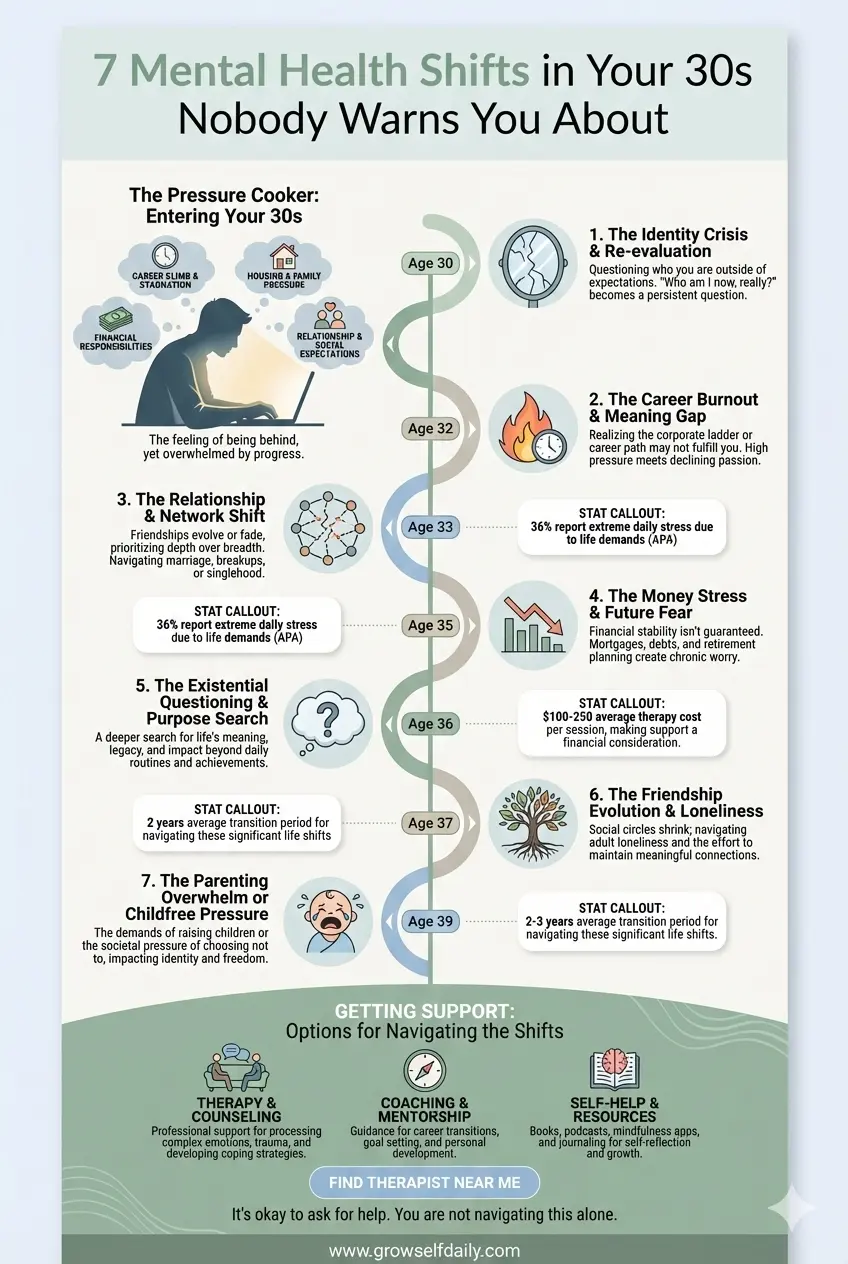

1) Identity Consolidation Feels Like Crisis
Your 20s were about exploring who you might become.
Your 30s demand you decide who you actually are.
Psychologists call this identity consolidation. All those possible futures collapse into the present reality of your actual life. The musician who became an accountant. The adventurer who settled into suburban routines. The person who always said “I’m not ready” now facing fertility timelines.
This transition creates unexpected grief.
You mourn versions of yourself that never materialized. The startup founder. The world traveler. The artist. Those identities weren’t failures, but they’re also not your reality. Processing that loss while building commitment to who you’ve become generates psychological tension your 20-year-old self never anticipated.
Research shows your 30s typically involve 2-3 years of transition as you reconcile who you’ve become with the life you’ve created. This isn’t failure. It’s normal developmental progression that feels destabilizing because nobody explains it’s coming.
The mental health impact shows up as anxiety about choices, depression related to “missed” opportunities, and persistent questioning of whether your current path reflects authentic values or just inertia from earlier decisions.
Why This Hits Harder Than Expected
Your 20s offered the comfort of “I’m still figuring it out” as a valid response to life questions.
Your 30s remove that excuse. Society expects answers. Your brain craves coherence. The gap between expected clarity and actual uncertainty creates stress that manifests as mental health struggles.
Friends start asking “so what do you do?” expecting crisp professional identities, not existential confusion. Family gatherings become performance anxiety triggers. LinkedIn profiles demand confident summaries of career trajectories you’re still questioning internally.
2) Career Burnout Becomes Inescapable Reality
Remember when work felt like opportunity?
Your 30s transform work into responsibility, expectation, and often burnout.
Studies show 84% of workers experience burnout due to increased workload, mental health challenges, and insufficient compensation. Your 30s hit peak career pressure as you’re expected to demonstrate expertise, climb hierarchies, and produce results while questioning whether any of this matters.
The psychological mechanism differs from 20s work stress. Early career anxiety focused on proving capability and finding footing. Thirties burnout stems from realizing you proved yourself but the rewards feel hollow, or that competence brought more work instead of more meaning.
Many people describe feeling trapped. Too invested to quit. Too experienced for entry-level pivots. Too responsible (mortgages, families, debt) for risky career changes. This sense of being stuck generates depression and anxiety distinct from earlier life stages.
Mental health manifestations include chronic exhaustion without rest benefits, cynicism about work previously enjoyed, reduced professional efficacy despite experience, and persistent thoughts about escape that feel simultaneously urgent and impossible to act on.
The Meaning Crisis Underlying Burnout
Burnout isn’t just overwork.
Research links it to misalignment between values and daily activities. Your 30s often reveal gaps between why you chose your career and what you’re actually doing. The idealistic teacher facing bureaucracy. The doctor confronting insurance barriers. The creative professional executing corporate mandates.
This values-reality disconnect drains mental energy faster than long hours alone. You question whether continuing makes you pragmatic or just complicit in your own unhappiness. Discover burnout recovery techniques.
3) Relationship Realignment Creates Unexpected Loneliness
Friendships that felt permanent start feeling fragile.
Your 30s bring relationship realignment as life paths diverge. Married friends pull into couple-focused social circles. Parents disappear into child-rearing demands. Geographic moves scatter tight-knit groups. Different priorities create gaps where closeness existed.
This isn’t dramatic falling out. It’s slow drift that feels somehow worse. You notice weeks passing without texting friends you once messaged daily. Group chats go silent. Invitations decline. Everyone’s busy, sure, but the cumulative effect is loneliness even when technically surrounded by people.
Research shows relationship struggles intensify in your 30s because connections carry more emotional weight. Friendships represent stability and belonging during a decade defined by transitions. Losing or changing these relationships threatens psychological foundations exactly when you need them most.
Dating dynamics shift too. If single, apps feel exhausting and superficial. If partnered, relationships face new pressures around commitment, children, finances, and life direction. The ease of 20s relationships gives way to complex negotiations about futures that feel increasingly consequential.
Many people report feeling lonely despite having partners, families, or full social calendars. The loneliness stems from lack of deep connection and authentic relating, not absence of bodies in proximity. Your mental health suffers when surface relationships replace the vulnerable intimacy that sustained you earlier.To understand the deeper patterns behind these behaviors, explore our complete guide to relationship psychology.
4) Financial Anxiety Reaches Critical Mass
Money stress always existed.
Your 30s make it existential.
Student loans from your 20s still demand payment while mortgages, weddings, potential children, aging parents, and retirement planning all compete for resources simultaneously. The psychological burden of financial decisions compounds as consequences feel permanent rather than temporary.
Buying a house locks you to location and monthly obligations. Having children creates decades of financial responsibility. Career changes risk income stability. Every choice carries weight your 20-year-old self never grasped.
Studies show financial stress specifically impacts mental health by triggering anxiety about future security, shame about perceived inadequacy (comparison to peers or expectations), and decision paralysis when choices feel equally problematic.
The therapy cost question itself illustrates this pressure. Mental health therapy averages $139 per session in 2024, with costs ranging from $65-250 depending on location and provider credentials. Insurance helps (average $23 copay in-network), but many therapists don’t accept insurance, leaving people choosing between mental health care and other financial obligations.
This creates a cruel paradox. Financial stress damages mental health. Therapy costs add financial stress. The cycle perpetuates unless addressed strategically. Find affordable mental health support options.
The Comparison Trap Magnifies Money Anxiety
Social media turns financial anxiety toxic.
Your 30s hit peak comparison vulnerability as peers post vacations, home purchases, promotions, and family milestones. Each highlight reel triggers internal assessments of your financial position.
Research shows comparison-based stress increases when life stage expectations (home ownership, starting families, career success) create measurable benchmarks. Your brain interprets financial gaps as personal failures rather than systemic inequalities or different priorities, feeding depression and anxiety.
5) Existential Questions Demand Answers
Why am I here? What’s the point? Is this all there is?
Existential questioning hits different in your 30s.
Your 20s allowed philosophical musings without urgency. Your 30s demand engagement with meaning because time feels suddenly finite. Mortality awareness increases. Parents age visibly. Friends face health scares. The abstract future becomes concrete present.
This existential shift manifests as mental health challenges when people lack frameworks for addressing big questions. Depression stems from perceived meaninglessness. Anxiety from uncertainty about purpose. Restlessness from suspicion that current life doesn’t reflect authentic values.
Many describe feeling like they’re living someone else’s life. Following scripts inherited from family, culture, or circumstance rather than conscious choice. The dissonance between authentic self and performed life creates persistent psychological discomfort.
Research links existential distress in your 30s to the “settling down” paradox. Life stabilizes externally (jobs, relationships, routines) creating mental space for bigger questions that instability previously crowded out. Suddenly you have time to wonder if stability equals the life you want.
6) Friendship Evolution Brings Unexpected Grief
You outgrow people.
They outgrow you.
Your 30s force confrontation with natural friendship lifecycles. Some relationships served specific life stages beautifully but don’t translate to new phases. College bonds. Work friendships. Shared-hobby connections. Geography and life changes expose which friendships were circumstantial versus foundational.
This evolution creates legitimate grief. You mourn friendships while they’re technically still alive. People exist but connection faded. Texts feel obligatory. Meetups require effort that used to flow naturally. The loss hurts despite no clear ending point.
Mental health suffers because social support networks protect against stress, depression, and anxiety. Research shows strong relationships directly support mental and physical health across life stages. Losing or changing core friendships removes protective factors exactly when your 30s demand maximum resilience.
The added complication? Making new friends as an adult feels impossible. Work colleagues rarely transcend professional boundaries. Dating apps don’t solve platonic loneliness. Hobbies provide activity partners but deep connection requires vulnerability most adults struggle to access with strangers.
People describe feeling socially “stuck.” Relationships that no longer fit but fear of being alone prevents necessary endings. Or wanting deeper connections but lacking energy after work, family, and basic responsibilities consume available bandwidth.
7) Parenting Pressure Breaks Mental Health
For those who become parents in their 30s, this decade brings specific mental health challenges.
Postpartum depression and anxiety affect significant percentages of new parents. But beyond clinical diagnoses, the daily reality of parenting triggers identity loss, isolation, sleep deprivation, relationship stress, and crushing pressure to perform “perfect” parenting while maintaining careers and personal wellbeing.
The mental load of parenting (endless invisible labor managing schedules, supplies, needs, appointments) creates cognitive burden that leaves little capacity for processing your own emotions or needs. You exist in permanent reactive mode, addressing immediate demands while your mental health quietly deteriorates.
Society romanticizes parenthood while stigmatizing honest struggle. Admitting difficulty feels like failing. Seeking help suggests inadequacy. The gap between expected joy and actual exhaustion generates shame that compounds anxiety and depression.
For those choosing not to have children, different pressures emerge. Defending decisions to family. Managing grief if childlessness isn’t chosen. Navigating friendships where parent identities dominate. Either path carries mental health implications specific to your 30s.
Related Relationship Guides
If you’re exploring emotional growth and relationships, these guides may help:
• Relationship Psychology: Complete Guide
• Signs Someone Is Constantly Thinking About You
• Signs of Emotional Attachment
• How to Stop Overthinking About Someone You Like
The Decision Itself Creates Stress
Even choosing whether to parent generates psychological pressure.
Fertility timelines create urgency. Partner alignment matters. Financial readiness feels elusive. Career impacts loom. The decision carries permanence that earlier life choices lacked.
Many people describe decision paralysis. Waiting for certainty that never arrives. Deferring until “ready” while biological and social clocks tick. The mental health toll of chronic indecision rivals the challenges of either choice.
How to Strengthen Mental Health in Your 30s
Understanding these psychological shifts helps, but supporting your mental health requires active strategies.
Research consistently shows certain approaches improve mental health outcomes during this challenging decade.
Decide Between Therapy, Coaching, and Self-Help
Your 30s often demand professional support. Knowing which type helps guides effective action.
| Option | Best For | Average Cost | Key Benefit |
| Therapy | Clinical symptoms, trauma, mental health diagnoses | $65-250/session, $23 average with insurance | Evidence-based treatment, insurance coverage possible |
| Coaching | Goal-setting, career transitions, life direction | $100-300/session, rarely covered by insurance | Future-focused, accountability, strategy |
| Self-Help | Mild stress, personal growth, supplementing therapy | $0-50 (apps, books, online resources) | Flexible, private, immediately accessible |
Therapy addresses mental health conditions (depression, anxiety, trauma) through evidence-based treatment like Cognitive Behavioral Therapy. Licensed therapists diagnose and treat clinical issues, working with past experiences and present symptoms.
Coaching focuses on future goals without treating mental illness. Life coaches, career coaches, and executive coaches help clarify direction, build accountability, and develop strategies for success. Unregulated industry means credentials vary.
Self-help includes apps (Headspace, Calm, BetterHelp messaging), books, online communities, and mindfulness practices. Effective for mild stress and personal development but insufficient for clinical mental health needs.
Many people benefit from combinations. Therapy for underlying anxiety plus coaching for career transitions. Meditation apps supplementing weekly therapy sessions. Compare therapy and coaching options.
Find Affordable Mental Health Support
Cost prevents many from accessing needed care.
Practical strategies reduce barriers:
- Check insurance coverage and in-network providers before assuming costs
- Ask about sliding scale fees based on income (many therapists offer reduced rates)
- Try community mental health centers (often $20-50 per session or free)
- Explore online therapy platforms (Talkspace $69+/week, BetterHelp similar pricing)
- University training clinics offer supervised sessions at reduced costs
- Employee Assistance Programs provide free sessions through employers
- Open Path Collective connects to affordable therapists ($30-80/session)
Research shows Americans spend average $1,080 yearly on mental health treatment (about $90/month or 5% of monthly income). Nearly 10% incur debt for treatment. But affordable options exist when you know where to look.
Build Daily Mental Health Practices
Professional support matters, but daily habits form your mental health foundation.
Evidence-based practices include:
Mindfulness meditation. Even 10 minutes daily reduces anxiety and improves emotional regulation. Apps like Headspace guide beginners. Research shows consistent practice rewires stress response patterns.
Regular physical activity. Exercise produces neurochemical changes that combat depression and anxiety. Thirty minutes most days delivers measurable mental health benefits regardless of intensity.
Sleep hygiene. Your 30s demand consistent 7-9 hours. Sleep deprivation exacerbates every mental health challenge. Prioritize bedtime routines and sleep schedule consistency.
Social connection. Schedule regular contact with supportive people. Quality matters more than quantity. One deep friendship supports mental health better than dozens of superficial connections.
Boundary setting. Learn to say no. Protect time and energy for recovery. Boundaries prevent burnout and resentment that damage mental health.
Digital detox. Limit social media and news consumption. Comparison and information overload trigger anxiety. Intentional breaks restore mental clarity.
People Also Ask
What are the most common mental health challenges in your 30s?
The most common mental health challenges in your 30s include anxiety related to life decisions and timelines, depression from identity consolidation and unfulfilled expectations, career burnout from prolonged workplace stress, relationship struggles as social networks evolve, financial anxiety from competing obligations, existential questioning about meaning and purpose, and parenting-related stress for those with children. Research shows 36% of people aged 35-39 report extreme daily stress, with age 36 identified as the most stressful year. These challenges stem from simultaneous pressure across career, relationships, finances, and identity development.
Is therapy worth it in your 30s and how much does it cost?
Therapy provides significant value in your 30s by addressing decade-specific challenges like identity transitions, career burnout, and relationship stress. Average costs range $65-250 per session without insurance, or $23 average copay with in-network coverage. Online therapy platforms charge $69-109 weekly. Many therapists offer sliding scale fees, and community centers provide low-cost options ($20-50/session). Research shows therapy helps develop coping strategies, process transitions, and prevent long-term mental health deterioration. Investment in therapy during your 30s often prevents more severe issues later while building skills for lifelong emotional resilience.
How do I find a good mental health therapist near me?
Find quality therapists near you through these methods: check your insurance provider directory for in-network options, search Psychology Today therapist directory with filters for location/specialization/cost, ask your primary care doctor for referrals, contact community mental health centers for local resources, explore employee assistance programs offering free sessions, try university training clinics with supervised therapists at reduced rates, and ask trusted friends for recommendations. Schedule consultations with 2-3 therapists before committing. Good fit matters more than credentials alone. Evaluate their approach, specializations, availability, and whether you feel comfortable opening up during initial sessions.
What’s the difference between therapy and coaching for mental health?
Therapy and coaching serve different purposes. Therapy addresses mental health conditions (anxiety, depression, trauma) through evidence-based treatment by licensed professionals who diagnose and treat clinical issues. Focus includes past experiences and present symptoms. Insurance often covers therapy. Coaching helps with future goals, life transitions, and performance without treating mental illness. Coaches (unregulated profession) provide accountability, strategy, and guidance for career, relationships, or personal development. Insurance rarely covers coaching. Choose therapy for clinical mental health needs, coaching for goal achievement and direction, or combine both for comprehensive support during your 30s transitions.
How to cope with burnout and stress in your 30s?
Cope with burnout through: setting firm boundaries between work and personal time, taking regular breaks throughout workdays, seeking therapy or coaching for professional support, evaluating whether current career aligns with values, building daily stress management practices (meditation, exercise, sleep hygiene), connecting with supportive friends and family regularly, exploring sabbaticals or reduced schedules if financially viable, and addressing underlying causes rather than just symptoms. Research shows burnout stems from values-work misalignment, not just overwork. Recovery requires both immediate stress reduction and deeper examination of whether your life structure supports sustainable wellbeing.
When Burnout Becomes Crisis
Burnout doesn’t always resolve with vacation or boundary-setting.
Sometimes it signals deeper misalignment requiring major life changes. Career pivots. Relationship endings. Geographic moves. Lifestyle overhauls.
Your 30s force confrontation with whether incremental adjustments suffice or fundamental restructuring becomes necessary. This decision carries massive psychological weight because stakes feel higher than in your 20s.
Mental health deteriorates when you know change is needed but fear prevents action. The gap between current reality and required transformation creates persistent anxiety and depression that self-care practices cannot resolve alone.
Professional support helps navigate these crossroads. Therapists provide space to explore options without judgment. Coaches offer strategic frameworks for transitions. Both help distinguish between temporary burnout and signs your current life structure fundamentally doesn’t work. Understand mental burnout and emotional exhaustion.
Resetting Your Life Mentally in Your 30s
Sometimes you need a complete mental reset.
Not running away from problems but intentionally restructuring your internal and external life to align with authentic values discovered through your 30s experiences.
Mental resets might include therapy to process accumulated trauma and stress, sabbaticals from careers to gain clarity and rest, ending relationships that no longer serve growth, relocating to environments that support wellbeing, or simplifying commitments to focus on what truly matters.
These decisions terrify because consequences feel permanent. But continuing patterns that damage mental health carries equally serious long-term costs. Your 30s demand courage to choose discomfort of change over comfort of familiar suffering. Learn how to reset your life mentally.
Navigating Relationship Changes
When friendships or romantic relationships shift in your 30s, the psychological impact runs deep.
People pulling away triggers abandonment fears and self-worth questioning. You wonder what you did wrong. Whether you’re fundamentally unlikable. If everyone eventually leaves.
Reality? Most relationship changes in your 30s reflect natural evolution, not personal failure. Life stages diverge. Priorities shift. Geographic distance creates gaps. Parenthood absorbs bandwidth. Career demands limit availability.
Processing these changes requires accepting that good relationships can end not from conflict but from growth in different directions. Grieving what was while remaining open to what comes next. Discover how to respond when someone is pulling away.
Your mental health benefits from quality over quantity in relationships. Three deep connections support wellbeing better than dozens of superficial ones. Your 30s teach you to invest strategically in relationships that reciprocate care and align with who you’re becoming.
The Body Image Shift in Your 30s
Your relationship with your body changes in your 30s.
Metabolism slows. Recovery takes longer. Body composition shifts despite similar habits. Comparing your 30s body to your 20s body generates unnecessary psychological distress.
Mental health improves when you shift from body positivity (loving your body) to body neutrality (accepting your body without requiring love). Your body becomes vehicle for living rather than decoration for others.
This mental shift reduces anxiety about appearance while maintaining health-promoting behaviors. You exercise because it feels good, not to punish yourself. You eat foods that support energy, not to earn body acceptance. Explore benefits of body positivity and understand body positivity vs body neutrality.
Your 30s offer opportunity to heal relationships with your body damaged by diet culture and impossible beauty standards. This healing directly supports mental health by reducing shame, anxiety, and self-criticism that drain emotional resources.
Taking Action on Your Mental Health
Understanding these psychological shifts matters.
Taking action matters more.
Start where you are. Pick one strategy from this article. Implement it this week.
Schedule a therapy consultation. Download a meditation app and practice 10 minutes daily. Reach out to one friend for genuine connection. Set one boundary at work. Get eight hours of sleep tonight.
Small actions compound into massive mental health improvements over time. Your 30s don’t have to be a decade of suffering through transitions alone.
Professional support, daily practices, honest relationships, and self-compassion create foundations for not just surviving your 30s but using this decade for genuine growth and wellbeing.
Strengthen Your Mental Health Today
Transform how you navigate the psychological challenges of your 30s through evidence-based strategies, professional support, and daily practices that actually work.
Explore comprehensive mental health after 30 resources
Conclusion
Mental health in your 30s follows predictable patterns nobody warns you about.
Identity consolidation stress. Career burnout reality. Relationship realignment loneliness. Financial anxiety peaks. Existential questioning demands. Friendship evolution grief. Parenting pressure overwhelm.
These aren’t personal failures or signs something’s wrong with you. They’re normal developmental challenges affecting millions navigating this decade simultaneously.
The psychological shifts hit hard because your 30s remove the “still figuring it out” excuse while piling on responsibilities across career, relationships, finances, and identity. Society expects clarity. Your brain craves coherence. The gap generates real mental health struggles.
But understanding these patterns empowers you to respond strategically instead of suffering silently. Therapy addresses clinical needs. Coaching guides transitions. Daily practices build resilience. Honest relationships provide support. Self-compassion replaces judgment.
Your 30s don’t have to break you. With proper support and intentional strategies, this decade becomes the foundation for lifelong mental health and authentic living.
The seven psychological shifts covered here explain your experience. The coping strategies provide paths forward. The resources connect you to professional support.
What you do with this information determines whether your 30s represent crisis or transformation.
Choose transformation. Your mental health deserves investment, protection, and prioritization. Not someday. Today.