
Table of Contents
I used to think podcasts during chores meant I was procrastinating.
Avoiding silence. Filling dead air. Making boring tasks bearable.
Turns out, I was accidentally training relational skills psychologists spend years teaching clients.
Research shows something fascinating about people who listen to podcasts while doing chores. A BBC Global News neuroscience study found engagement increases 18% and emotional intensity jumps 40% when listening to podcasts while active compared to passive listening.
Your brain processes audio content differently when your hands are busy.
Six specific relational skills develop through this practice. Skills most people work hard to build. Skills podcast listeners develop without trying.
The Psychology Behind Podcast Listening During Chores
Your brain loves combining physical tasks with audio learning.
The science explains why.
Physical movement while listening boosts engagement. Studies show this active listening leads to 22% increase in long-term memory encoding of content compared to sitting still.
Chores create the perfect cognitive environment.
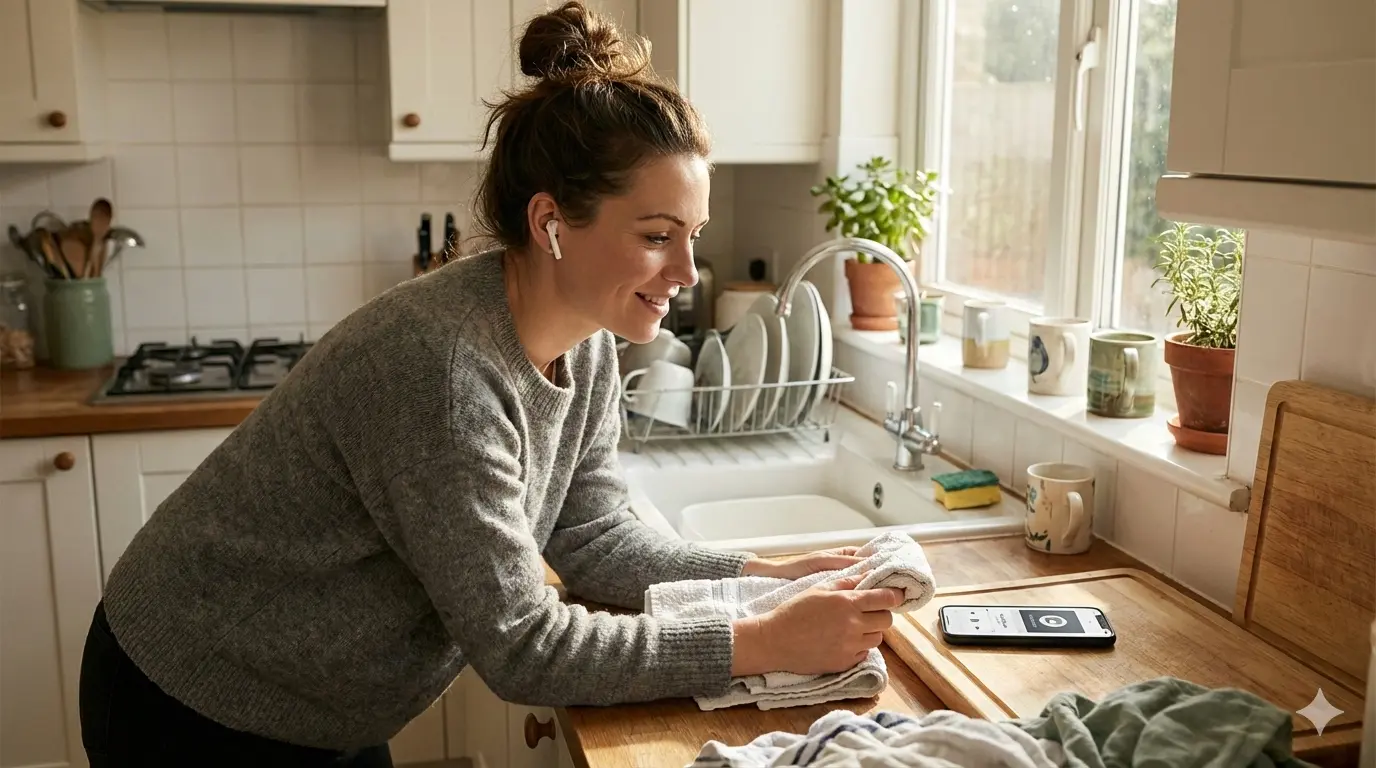
Folding laundry, washing dishes, organizing spaces. These tasks occupy your hands and basic motor planning. But they leave your higher cognitive functions available for processing complex information.
This split attention actually helps learning.
Research on media psychology describes podcasts as an “intimate medium.” Listeners develop parasocial relationships with hosts. You feel like they’re speaking directly to you, creating one-on-one atmosphere.
This intimacy strengthens when you’re alone doing chores.
No visual distractions. No performance pressure. Just voices in your ear while you fold shirts.
The combination builds skills people don’t realize they’re developing.
Skill 1: Enhanced Empathy Through Perspective-Taking
Podcasts expose you to hundreds of different perspectives.
Not in abstract ways. In intimate, personal ways.
People who listen to podcasts while doing chores hear life stories while sorting laundry. Learn about experiences nothing like their own while scrubbing counters. Process worldviews different from theirs while organizing closets.
This builds empathy through repetition.
Every interview introduces new ways of seeing. Every memoir segment reveals different struggles. Every panel discussion shows how people disagree respectfully.
Your brain processes these perspectives during low-stakes activities.
No pressure to respond. No need to defend your position. You’re just listening, absorbing, considering.
This creates space for genuine understanding.
Why Chore-Based Listening Amplifies Empathy Development
Something about mundane tasks opens your mind.
When you’re focused on performance or productivity, defenses stay up. You evaluate information critically. Judge quickly. Dismiss perspectives that challenge yours.
But folding laundry?
Your guard drops. Your critical voice quiets. You’re more receptive to different viewpoints because you’re not threatened by them.
The physical rhythm of chores creates mental openness.
Repeated motions. Predictable patterns. This soothes your nervous system while podcast content expands your worldview.
People who listen to podcasts while doing chores practice empathy hundreds of hours yearly without realizing it.
Skill 2: Active Listening Practice in Low-Pressure Settings
Active listening is hard.
Staying focused. Processing meaning. Remembering details. Most people struggle with this during important conversations.
Podcast listeners train this skill daily.
Every episode requires sustained attention. You follow complex arguments. Track multiple speakers. Remember context from earlier segments.
All while your hands do something else.
This builds listening stamina.
Research shows attention levels during podcast listening match focused reading. Your brain engages deeply even when multitasking with physical tasks.
The practice transfers to conversations.
From Podcast Episodes to Real Conversations
People who listen to podcasts while doing chores get better at conversations without formal training.
They’ve practiced following narratives. Tracking arguments. Holding information in working memory while processing new input.
These are the exact skills needed for good conversation.
You listen to someone’s story. Remember the beginning while they’re in the middle. Notice themes. Ask relevant questions.
Podcast habits build this capacity.
The intimacy of podcast listening teaches you to stay present with voices. To follow threads. To notice nuance in tone and word choice.
Your chore time becomes conversation training you didn’t sign up for.
Skill 3: Emotional Intelligence Through Self-Awareness
Certain podcasts promote reflection.
Therapy shows. Personal development content. Interview series where people discuss growth and challenges.
People who listen to podcasts while doing chores absorb this reflective content during quiet moments.
You’re alone. Hands busy. Mind available.
When hosts discuss anxiety, you notice your own. When guests describe relationship patterns, you recognize yours. When topics touch emotional wounds, you feel them.
This builds self-awareness organically.
The physical task creates emotional safety. You’re not sitting still confronting your stuff directly. You’re washing dishes while insights sneak past your defenses.
Emotional intelligence grows through this repeated exposure.
Processing Emotions While Your Hands Stay Busy
Something therapeutic happens during chores.
Your body moves rhythmically. Your mind processes content. Emotions surface without overwhelming you.
Psychologists call this bilateral stimulation.
Repetitive physical movement while processing emotional material helps integrate insights. EMDR therapy uses similar principles.
People who listen to podcasts while doing chores accidentally create therapeutic conditions.
The podcast raises awareness. The physical task regulates your nervous system. Understanding deepens without flooding.
You finish dishes with clarity you didn’t have starting them.
Skill 4: Exposure to Broader Perspectives and Ideas
Your social circle is limited.
Same backgrounds. Similar worldviews. Predictable opinions.
Podcasts break this bubble.
People who listen to podcasts while doing chores encounter ideas they’d never hear otherwise. Expertise outside their field. Cultures different from theirs. Viewpoints that challenge assumptions.
This exposure builds cognitive flexibility.
Every new perspective expands how you think. You learn there are multiple valid approaches to problems. Different values leading to different conclusions. Various life paths that work.
This flexibility shows up in relationships.
How Diverse Content Improves Social Skills
When you regularly hear different perspectives, you stop expecting everyone to think like you.
This is huge for relationships.
People who listen to podcasts while doing chores develop tolerance for difference. Not theoretical tolerance. Practical, embodied understanding that people see things differently and that’s okay.
You’ve spent hours listening to viewpoints you don’t share.
This trains you to stay curious instead of defensive when friends disagree. Ask questions instead of arguing. Seek understanding instead of winning.
The podcast habit makes you less rigid socially.
Skill 5: Better Conversation Topics and Social Connection
People who listen to podcasts while doing chores always have something interesting to discuss.
Not small talk. Real topics.
You heard a fascinating interview about memory. Learned about urban planning challenges. Discovered a perspective on parenting you hadn’t considered.
This content becomes conversation fuel.
You bring fresh ideas to discussions. Reference interesting research. Share stories that spark deeper exchanges.
This makes you better company.
From Podcast Content to Meaningful Dialogue
The transfer happens naturally.
Something from Tuesday’s podcast comes up in Thursday’s lunch conversation. You share the insight. Your friend adds their experience. Suddenly you’re having substantive dialogue instead of weather chat.
People who listen to podcasts while doing chores feed their minds consistently.
This consistent input creates consistent output. You’re not scrambling for conversation topics. You’re not stuck in surface-level exchanges.
Your mental library stays stocked with current, interesting material.
Relationships deepen when conversations go beyond logistics and complaints.
Skill 6: Cognitive Flexibility From Productive Multitasking
Not all multitasking hurts performance.
Heavy media multitasking (scrolling while watching while texting) damages attention. Research shows clear cognitive costs.
But pairing physical tasks with audio learning works differently.
People who listen to podcasts while doing chores engage in what researchers call “productive multitasking.” Physical movement enhances rather than disrupts audio processing.
This builds a specific cognitive skill.
Your brain learns to manage two information streams simultaneously. One physical, one auditory. Neither interfering with the other.
This capacity transfers to complex social situations.
Training Your Brain to Process Multiple Channels
Good conversations require tracking multiple things at once.
Words being said. Tone and body language. Your own responses forming. Context from earlier in the exchange.
People who listen to podcasts while doing chores train this multi-channel processing daily.
You track podcast narrative while executing physical tasks. Remember what the host said five minutes ago while folding the current shirt. Connect ideas across segments while your hands stay busy.
This builds mental flexibility.
Studies on multitasking show context matters enormously. Switching between screens damages focus. But physical tasks paired with audio content enhances engagement and memory.
The right kind of multitasking makes you sharper, not scattered.
Quick reality check: These skills don’t develop from mindless background noise. Quality matters. Engaging podcasts that make you think, feel, or see differently create the learning environment. Random entertainment provides different benefits. The relational skills emerge from content that challenges, educates, or expands your perspective while your hands stay productively busy.
The Science of Why This Works
Several psychological mechanisms explain these benefits.
First, the intimate nature of podcast listening creates what researchers call parasocial relationships. You feel connected to hosts. This emotional engagement enhances learning and retention.
Second, physical movement during listening increases both engagement and memory encoding. Your brain processes information more deeply when your body moves rhythmically.
Third, chores provide the perfect cognitive load balance.
Tasks too demanding prevent audio processing. Tasks too easy allow mind-wandering. Moderate physical tasks (dishes, laundry, organizing) occupy just enough attention to enhance focus on audio content without overwhelming it.
Fourth, the consistency matters.
People who listen to podcasts while doing chores engage in regular, repeated practice. Skill development requires repetition. You’re training relational capacities hundreds of hours yearly.
Finally, the low-pressure environment supports learning.
No performance anxiety. No social evaluation. Just you, your chores, and voices teaching you how people think, feel, and communicate.
Choosing Content That Builds Relational Skills
Not all podcasts develop these skills equally.
Shows focused on empathy, communication, psychology, and diverse perspectives provide the biggest benefits.
**Content types that build relational skills:**
Interview shows where people share personal stories. You hear how others navigate challenges, process emotions, and find meaning.
Therapy and psychology podcasts that explain human behavior. You learn frameworks for understanding yourself and others.
Diverse perspective shows featuring voices different from yours. You expand your worldview through exposure.
Conversational podcasts where hosts model healthy dialogue. You observe respectful disagreement, active listening, and collaborative thinking.
Narrative storytelling that builds empathy through immersion. You experience lives unlike your own intimately.
The pattern? Content that makes you think about people deeply.
When Podcast Listening During Chores Doesn’t Help
Some patterns don’t build these skills.
Pure entertainment podcasts provide enjoyment without relational development. Nothing wrong with this. Just different benefits.
Background noise you’re not actively following. If you’re tuned out, you’re not training attention or empathy.
Constant switching between shows without completing episodes. Fragmenting attention prevents the deep processing that builds skills.
Using podcasts to avoid your thoughts entirely. Some reflection time matters for integrating insights.
Choosing only content confirming existing beliefs. Growth requires exposure to different perspectives.
The skills develop when you’re engaged, completing content, and open to new ideas.
FAQ: Podcasts, Chores, and Relational Skills
Can listening to podcasts improve social skills?
Yes, listening to podcasts improves specific social skills including active listening, empathy, conversation depth, and perspective-taking. Research shows podcast listeners develop parasocial relationships with hosts that strengthen emotional engagement and learning. People who listen to podcasts while doing chores practice sustained attention for extended periods, training the focus needed for quality conversations. Exposure to diverse perspectives through podcast content also builds cognitive flexibility and reduces rigid thinking in social situations. The intimate nature of audio consumption creates ideal conditions for absorbing communication patterns and emotional intelligence concepts. However, benefits depend on content quality and engagement level. Passively hearing background noise doesn’t provide the same skill development as actively following shows that challenge thinking and expand worldviews.
How does multitasking with podcasts affect relationships?
Multitasking with podcasts during physical tasks affects relationships positively when done thoughtfully. Unlike harmful media multitasking (multiple screens simultaneously), pairing podcasts with chores creates productive multitasking. Research shows physical movement while listening increases engagement and memory encoding. This practice builds relational skills that transfer to interactions: better active listening from practicing sustained attention, enhanced empathy from exposure to diverse stories, improved conversation topics from consistent content consumption, and stronger emotional intelligence from reflective podcast material. People who listen to podcasts while doing chores also develop patience and tolerance for different viewpoints through regular exposure to various perspectives. The key distinction is that physical tasks paired with audio content enhance rather than disrupt cognitive processing, unlike screen-based multitasking which fragments attention and reduces relationship quality.
What are the benefits of listening to podcasts while doing chores?
Listening to podcasts while doing chores offers multiple psychological and practical benefits. Engagement increases 18% and emotional intensity rises 40% compared to passive listening, according to BBC Global News neuroscience research. Memory encoding improves by 22% when physically active during podcast consumption. Mundane tasks become learning opportunities, transforming wasted time into personal development. The practice builds six specific relational skills: enhanced empathy through diverse perspectives, active listening practice, emotional intelligence development, broader worldview exposure, better conversation abilities, and cognitive flexibility from productive multitasking. Additional benefits include stress reduction through rhythmic physical activity combined with engaging mental stimulation, motivation to complete boring tasks, and consistent knowledge acquisition without requiring dedicated study time. The combination creates optimal conditions for both task completion and deep learning that improves social functioning.
Are people who listen to podcasts while doing chores more empathetic?
People who regularly listen to podcasts while doing chores often develop greater empathy through repeated exposure to diverse perspectives and personal stories. The mechanism involves both the intimate nature of podcast listening and the receptive mental state created during routine physical tasks. When engaged in chores, psychological defenses lower, making listeners more open to viewpoints different from their own. Interview-based and narrative podcasts specifically build empathy by providing detailed windows into experiences unlike the listener’s life. This exposure trains perspective-taking, the cognitive foundation of empathy. Research on parasocial relationships shows podcast listeners develop genuine emotional connections with hosts and guests, strengthening capacity for understanding others’ feelings and motivations. However, empathy development depends on content choices and engagement level. Listeners who seek out diverse voices and challenging perspectives gain more empathy skills than those consuming only entertainment or opinion-confirming content.
Can podcasts make you a better communicator?
Yes, podcasts improve communication skills through multiple pathways. Listening to quality podcasts trains active listening, the foundation of good communication. You practice following complex narratives, tracking multiple speakers, and maintaining attention over extended periods. This builds stamina for real conversations where you must process information while formulating responses. Podcast content also provides conversation models, showing you how skilled communicators ask questions, handle disagreements, and explore ideas collaboratively. People who listen to podcasts while doing chores accumulate hundreds of hours observing effective dialogue patterns. Additionally, varied podcast topics stock your mental library with interesting material, preventing conversations from stagnating in small talk. The practice develops vocabulary, exposes you to different communication styles, and teaches you to appreciate nuance in how people express themselves. Regular engagement with thoughtful podcast content creates noticeable improvements in conversational depth, listening quality, and ability to discuss complex topics accessibly.
The Hidden Gift of Podcast-Enhanced Chores
People who listen to podcasts while doing chores aren’t just making boring tasks bearable.
They’re building relational capacities most people work hard to develop.
Enhanced empathy. Active listening skills. Emotional intelligence. Broader perspectives. Better conversations. Cognitive flexibility.
Six skills emerging from a simple habit.
The beauty is the lack of effort required.
You’re not sitting through workshops. Not reading textbooks. Not forcing yourself through exercises.
You’re folding laundry while voices expand your worldview. Washing dishes while stories build your empathy. Organizing closets while ideas sharpen your thinking.
The physical tasks create the perfect learning environment.
Low pressure. Consistent practice. Emotionally safe. Your hands stay busy while your mind grows.
This isn’t about productivity hacks or optimization.
It’s about accidentally becoming a better person through routine activities enhanced by thoughtful content.
The relational skills don’t announce themselves.
You don’t finish an episode and suddenly understand empathy. The change happens gradually. Over weeks and months of exposure to different voices, perspectives, and ways of being.
One day you notice you’re better at conversations. More patient with different viewpoints. Quicker to understand where someone’s coming from.
These shifts trace back to hundreds of hours spent listening while your hands stayed productive.
So next time someone questions your podcast habit during chores?
You’re not procrastinating. You’re not avoiding silence. You’re not wasting time.
You’re training relational skills psychology professors teach in graduate programs.
You’re just doing it with headphones in while folding laundry.
Ready to explore more ways everyday habits build psychological strengths? Discover how small daily practices develop lasting emotional intelligence and see what other routine activities secretly shape who you’re becoming while also learning to Accept Your Body: 10 Powerful Ways To Stop Self-Criticism